

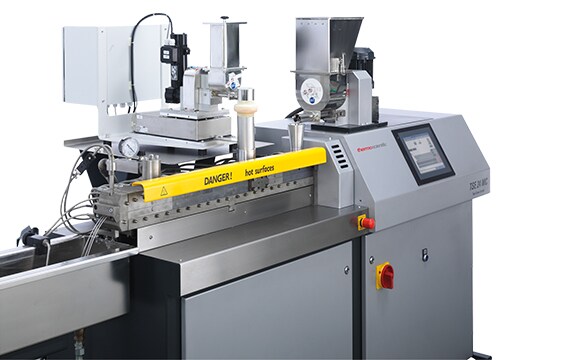
The manufacturing of complex materials is now driving by increasingly sophisticated formulations, where the quality of the final product – whether a high-performance polymer for the automotive industry or an active pharmaceutical ingredient – depends entirely on the mixing phase. Simply melting and shaping materials is no longer enough: ingredients, often expensive additives and technical fibers must be distributed with perfect uniformity. In this context, extrusion stands out as the benchmark physical transformation process. Among the configurations available, the twin screw extruder has earned technological leadership.
Operating principle: forced interaction and intensive mixing
The secret behind the efficiency of a twin-screw extruder lies in the dynamic interaction between its two parallel screws housed within the same barrel. Although counter-rotating configurations exist – where the screws turn in opposite directions – the co-rotating version (same direction) is by far the most common in the polymer and composite industries. The screws are designed with extremely tight intermeshing, meaning they interlock and interact as they rotate. This design forces the material to continuously transfer from one screw to the other, subjecting it to intense and deliberate shear, folding and mixing.
Unlike a single screw extruder, where the material largely flows along the screw axis, a twin screw extruder provides an active, continuous mixing process. The thermal energy required for melting does not come solely from external heaters: it is generated primarily by the internal friction imposed on the material itself. This mechanism ensures exceptional thermal homogeneity: a vital factor in preventing polymer degradation caused by localized overheating.
Strategic advantages: uniformity and flexibility
The architecture of a twin screw extruder offers several strategic advantages that justify its investment. The most evident is mixing quality: the intense mixing action enables flawless dispersion of additives, mineral fillers and pigments withing the polymer matrix. This is crucial for producing high-performance compounds, where even minimal inconsistency in fiber distribution (such as glass or carbon fiber) can compromise the final mechanical proprieties.
A second major advantage is operational flexibility. The shafts of a twin screw extruder are modular, meaning they are built from interchangeable screw elements. A technician can change the sequence and geometry of these elements using conveying, mixing or kneading components to adapt the machine to specific formulations. This immediate configurability is vital in production environments that process multiple material batches, reducing downtime and the cost of developing new compounds.
Impurity management and degassing
A third distinguishing feature that makes twin screw extruders superior is their ability to manage impurities. During extrusion, plastic material may release volatile substances, moisture or residual monomers, especially when using recycled materials or those insufficiently dried. A twin-screw extruder has dedicated degassing or venting section. These sections create low-pressure areas inside the barrel, allowing gases to be extracted by vacuum pumps before they can compromise the structural quality or surface appearance of the final product by creating bubbles or weak spots.
Industrial applications: a catalyst for innovation
Thanks to its versatility and precision, the twin screw extruder is a true catalyst for innovation across several industries.
Polymer and composite industry
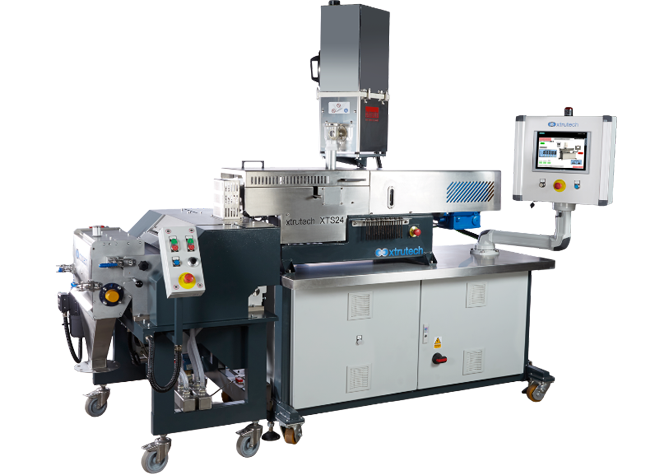
Twin-screw extruders are most widely used in the production of masterbatch (color concentrates), technical compounds for automotive and electronics (such as flame-retardant or conductive polymers) and in advanced polymer recycling, where heterogenous or degraded material must be re-homogenized.
Food industry
In the food industry the extruder works as a genuine cooking and shaping reactor. It is employed to produce breakfast cereals, snacks, pet food and textured vegetable proteins. In this context, heat and pressure modify molecular structure (starch gelatinization, protein denaturation), improving digestibility and sterilizing the food.
Pharmaceutical and chemical industries
Extrusion is increasingly used for hot-melt granulation of active pharmaceutical ingredients (Hot Melt Extrusion) and for the continuous, precise mixing of chemical substances. The process accuracy and traceability offered by twin screw extrusion are critical requirements for meeting the strict regulatory standards of these sectors.
Although the initial investment is significant, the ability of twin screw technology to process complex materials and deliver unmatched quality and uniformity makes it the benchmark system for innovation in modern manufacturing.