

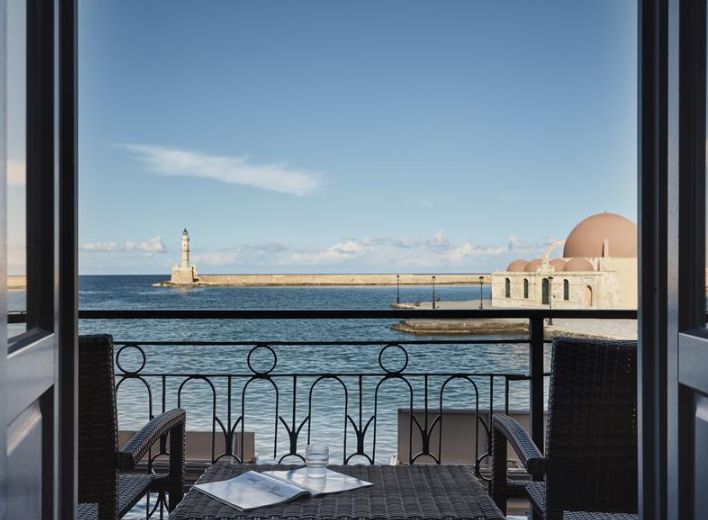
The first thing you notice about Chania’s Old Town is that it doesn’t care about modern right angles. To stay here is to step into a living, breathing architectural collision. For centuries, empires fought over this tiny patch of Cretan coast. The Venetians built massive, thick-walled palazzos with soaring stone arches; the Ottomans arrived later and added delicate, cantilevered wooden balconies that reach out across the narrow alleys; and today’s local designers have stepped into the middle of it all, turning these ancient footprints into some of the most intimate boutique spaces in the Mediterranean.
But because these buildings were constructed centuries before the concepts of modern hospitality, or even elevators, were born, choosing the right spot requires looking past the pretty photos and understanding the layout of the town.
Staying at a boutique hotel in Chania Old Town – Your Options
The Front Row: The Venetian Harbor
If you want the iconic postcard view, you stay on the waterfront. These properties face the open Aegean Sea and the famous Egyptian Lighthouse. In the morning, the light bounces off the water and fills the rooms; at dusk, the entire harbor turns a deep, moody amber.
The trade-off here is energy. You are on the frontline of Chania’s social life. Below your windows of your boutique hotel Chania Old Town, the promenade hums with strollers, outdoor dining, and evening chatter. The buildings themselves tend to be narrow and vertical, skinny, three-story palazzos where steep stone stairs replace elevators, and the sea breeze hits the facade directly. It’s dramatic, vibrant, and beautiful, but it is rarely quiet.
The Deep Hideaways: Topanas and the Jewish Quarter
Step just one block behind the harbor front, and the volume drops instantly. The alleys of Topanas shrink until they are only a few meters wide, well beyond the reach of cars or scooters.
Boutique spaces here don’t look outward at the sea; they look inward. They are built around hidden, open-air stone courtyards that were originally designed for privacy and passive cooling. Staying here means waking up to the sound of a distant church bell, looking out at bougainvillea spilling over sun-bleached stone, and feeling completely insulated from the tourist track. The rooms are often irregular, featuring cozy lofted mezzanines tucked under original cedar-beam ceilings to maximize the tight historical footprint.
The Local Pulse: Splanzia
On the eastern edge of the old walls lies Splanzia. This district feels less like a museum and more like a neighborhood. The tightly packed alleys occasionally break open into irregular, shady squares where locals drink coffee under massive plane trees.
Architecturally, it’s the most eclectic part of town, where a single glance can catch both an Orthodox belfry and an Ottoman minaret. The boutique properties here often enjoy slightly more breathing room, offering a blend of historical character and a front-row seat to actual, day-to-day Cretan life.
The Realities of the Labyrinth
Staying in an ancient port town means trading predictable resort luxuries for character. Because the historic center is heavily pedestrianized, your taxi can’t pull up to a sleek marble lobby. You’ll drop your bags at the edge of the old town perimeter, near the ruins of the Firka Fortress or the old market walls, and wheel them over centuries-old stone pavers to find your door.
You won’t find sprawling pool complexes or cookie-cutter room layouts. Instead, the luxury here is entirely structural: sub-floor cooling that keeps the room crisp without ugly plastic wall units, custom lighting that washes over a meter-thick sandstone wall, and the knowledge that the room you’re sleeping in has stood firm through centuries of history.


